How All Things Trust Measures Digital Credibility

Trust is the outcome. Credibility is what you can examine.

Short Answer

All Things Trust measures digital credibility by examining the observable signals that make trust more or less justified: source clarity, contextual fit, consistency, transparency, evidence access, and verification support. [3][7][12]

The output is not a general trust score or a sentiment readout. It is a diagnostic view of which credibility signals are strong, which ones are weak or poorly placed, and what teams should fix first.

Trust is often measured after the fact, through sentiment, reputation, surveys, reviews, complaints, conversion data, or customer behavior. Those signals matter, but they usually show that confidence has strengthened or weakened after the experience has already happened.

All Things Trust looks earlier in the chain. We examine whether public-facing and AI-mediated experiences give people and systems enough source clarity, contextual fit, consistency, transparency, and evidence to justify confidence in the first place.

The diagnostic shows where credibility is supported, where it breaks, and what needs to change first.

Triggers

You may need a digital credibility diagnostic when…

A digital credibility diagnostic is useful when the organization can feel that confidence is weakening, but the cause is hard to isolate.

Trigger
What May Really Be Happening
Conversion is dropping and the usual analytics do not explain why
People may understand the offer but lack enough proof, clarity, or risk support to act.
AI systems describe the organization inaccurately
The public record may be too vague, inconsistent, outdated, or unsupported.
Customer-facing AI is launching or scaling
The experience may pass review but still fail when users need limits, evidence, escalation, or human support.
Visibility is rising but sales or inquiries are not
Attention may be increasing without enough credibility at the decision point.
A board, legal, product, brand, or CX team has started asking trust questions
The organization may need a shared way to identify where credibility is supported, weak, or poorly placed.
Distinction

Why measuring credibility is different from measuring trust

Trust is often treated as a soft outcome: something people feel, report, express, or withdraw. It can show up in surveys, reviews, brand sentiment, complaints, loyalty, conversion, renewal, or customer behavior.

Credibility is different. It can be examined inside the experience itself.

A digital experience either makes sources clear or it does not. It either supports claims with usable evidence or it does not. It either explains limits, incentives, policies, and next steps clearly or it leaves people to infer them. It either helps AI systems represent the organization accurately or gives them fragmented, incomplete, or unsupported material to work with.

That is what All Things Trust measures: the visible and structured signals that help people and AI systems decide whether confidence is justified.

Scope

What the diagnostic examines

All Things Trust examines the experience layer: the public-facing and AI-mediated places where people and systems encounter an organization, interpret its claims, compare its options, assess its limits, and decide whether to act.

That can include websites, product pages, landing pages, search results, AI summaries, chatbot responses, recommendation flows, social content, reviews, FAQs, policies, support paths, onboarding moments, purchase journeys, comparison experiences, and other decision points where credibility is tested.

The diagnostic looks at how credibility signals appear across that experience:

Signal Area
What the Diagnostic Examines
Source clarity
Whether people and AI systems can tell who is speaking, where information comes from, and why the source should be trusted.
Claim support
Whether important claims are backed by evidence that is visible, relevant, and close enough to the claim.
Contextual fit
Whether the experience responds to the user’s situation, intent, risk level, and decision need.
Consistency
Whether the story, claims, policies, experience, and behavior hold together across touchpoints.
Transparency
Whether limits, trade-offs, incentives, policies, and next steps are understandable.
Verification support
Whether people and AI systems can check, corroborate, or validate important claims.
Escalation and support
Whether users can reach a person, expert, source, policy, or next step when the experience cannot resolve the issue.
AI representation
Whether AI summaries, search results, or answer engines preserve, omit, distort, or overstate the organization’s credibility signals.

It does not replace security, legal, compliance, identity, or governance work. It complements those efforts by examining what people and AI systems can actually see, understand, and verify from the outside.

Context

Measurement context

The Trust Stack was developed as an applied diagnostic model for evaluating credibility in digital and AI-mediated experiences. It was not built as a direct translation of one academic framework or as a validated psychometric scale.

After developing the model, All Things Trust reviewed adjacent research in web credibility, trust in automation, source evaluation, transparency, verification, and digital experience measurement. That research helps situate the work, sharpen the language, and clarify how the applied model relates to existing thinking.

The gap All Things Trust addresses is practical: organizations need a way to examine whether public-facing and AI-mediated experiences provide enough visible, usable, and verifiable support for people and AI systems to form justified confidence at decision points.

All Things Trust is also developing research pathways to test how the Trust Stack dimensions and signals relate to user confidence, hesitation, reliance, verification behavior, and willingness to act.

Beyond Scoring

Measurement is not just scoring

A score is only useful if it explains what is happening. All Things Trust uses scoring to organize evidence, compare strengths and weaknesses, and identify patterns across the experience. But the real value is the interpretation: which credibility signals are missing, which ones are present but poorly placed, which risks affect customer decisions, and which fixes should come first.

The goal is not to produce a score for display. The goal is to show where credibility is strong, where it is fragile, and where teams should act first.

Example

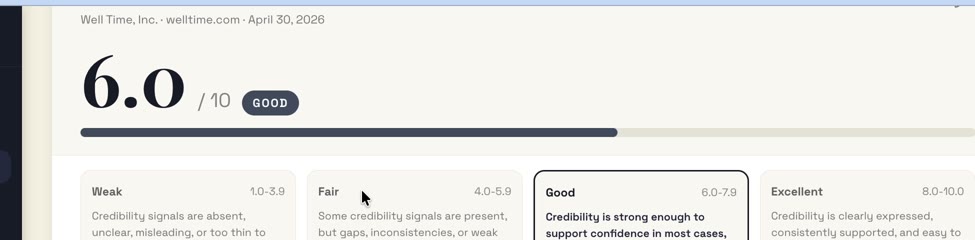
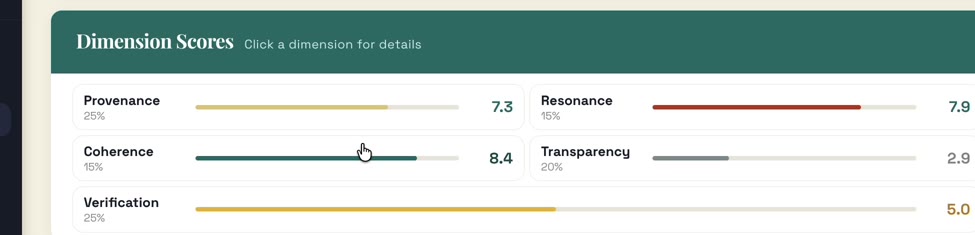
Sample diagnostic output

The public example below shows the shape of a finding without exposing the full scoring engine.

Diagnostic Component
Sample Output
Why It Matters
Overall interpretation
Credibility is strong in parts of the experience, but uneven at decision points.
Shows that the issue is not general trust, but where support breaks.
Strongest area
Coherence: the story holds together across most touchpoints.
The brand is understandable, but understanding is not the whole issue.
Weakest area
Verification: proof exists but is not close enough to claims or actions.
Evidence that is hard to find does less work.
Key finding
The strongest evidence is separated from the claims it supports.
Users and AI systems may not connect proof to the decision.
Priority recommendation
Move certifications, source links, claim support, review proof, and policy clarity closer to product and support decisions.
Improves confidence where hesitation appears.
Typical Finding

Sample finding and recommendation

A typical finding may look like this: The brand has expert content, certifications, reviews, policy disclosures, and a clear product story, but those signals are scattered across separate pages. Verification is weaker than the brand’s actual credibility because proof exists but is not usable at the decision point.

The recommendation would not be to add generic trust language. It would be to place certification evidence, claim support, review proof, policy clarity, and escalation paths near the exact moment of purchase, recommendation, comparison, or support resolution.

In other words, the issue is not always that credibility is absent. Often, the issue is that credibility is poorly placed.

Credibility Gaps

Where credibility gaps appear

A digital credibility diagnostic identifies where confidence weakens across the experience.

These gaps appear when people or AI systems encounter claims, complexity, risk, uncertainty, or decisions without enough support to interpret, verify, or act with confidence. A credibility gap may appear when:

Gap Type
Example
Proof is separated from the claim
A product claim appears on a purchase page, but the evidence sits in a separate article, PDF, or certification page.
Policies are technically available but hard to use
Return, privacy, eligibility, warranty, or support terms exist, but are buried or written in a way that does not help at the decision moment.
AI summaries flatten or distort the brand
Search or AI answers describe the organization in generic terms, omit proof, or overstate what the company offers.
The experience cannot handle edge cases
Users hit a chatbot or support path that cannot answer, cannot escalate, or cannot explain what to do next.
Signals conflict across channels
The website, reviews, social content, policies, and AI summaries create different impressions of the same organization.
Evidence exists but does not travel
Strong proof is available in one part of the ecosystem, but does not appear where users or AI systems need it.

The map helps teams see not just what is missing, but where credibility is being lost.

From Findings to Action

How findings become action

All Things Trust translates diagnostic findings into practical workstreams across brand, content, product, CX, legal, governance, and AI teams.

Workstream
Example Action
Functional optimization
Move proof, policies, source links, and support paths closer to decision moments.
Brand and content refinement
Clarify claims, reduce ambiguity, and make the credibility story easier to understand.
CX and product improvement
Identify where users hesitate, hit a wall, or lack the information needed to act.
Legal and governance coordination
Surface areas where disclosures, limits, policies, or evidence need to be clearer in the experience.
AI representation review
Examine how AI summaries, search results, or answer engines describe the organization.
Innovation opportunities
Identify new ways to make credibility visible, usable, and verifiable across emerging interfaces.

The point is not to turn credibility into another abstract metric. The point is to identify what needs to change, why it matters, and who should own it.

Teams Answer

What the diagnostic helps teams answer

A digital credibility diagnostic helps teams answer questions such as:

Question
Why It Matters
Are our strongest credibility signals visible where decisions happen?
Proof does less work when it is buried.
Do people and AI systems understand who we are, what we offer, and why our claims are justified?
Discovery and representation increasingly depend on structured, interpretable signals.
Are our claims supported by evidence close enough to the claim itself?
Unsupported or distant proof can increase hesitation.
Do our policies, limits, and support paths reduce confusion or add friction?
Transparency is not just disclosure. It has to be usable.
Does the experience hold together across channels and touchpoints?
Contradictions create doubt, even when individual assets look strong.
Where are users likely to hesitate, abandon, question, or escalate?
Credibility breaks most visibly at decision points.
How are AI systems representing us when customers ask questions?
AI-mediated discovery can reshape what people believe before they reach the brand directly.
How All Things Trust Helps

Running digital credibility diagnostics and giving teams a prioritized action plan

All Things Trust runs digital credibility diagnostics and gives teams a prioritized action plan: what to fix first, what business problem it affects, and who should own it.

The work can include Trust Stack diagnostics, AI summary reviews, decision-point audits, credibility gap analysis, scorecards, evidence reviews, and recommendation roadmaps across brand, content, CX, product, legal, governance, and AI teams. The diagnostic gives teams a shared view of where credibility is clear, where it is weak, and what to strengthen first.

Frequently Asked Questions

Common questions about measuring digital credibility

How do you measure digital credibility?
We examine observable experience-level signals such as source clarity, contextual fit, consistency, transparency, evidence placement, claim support, escalation paths, and AI representation. The goal is to understand whether people and AI systems have enough visible support to interpret, verify, and act with justified confidence.
A Trust Stack diagnostic can include findings across the five dimensions: Provenance, Resonance, Coherence, Transparency, and Verification. It may include a summary of strengths and vulnerabilities, credibility gaps, AI summary issues, decision-point risks, scorecards, evidence reviews, and prioritized recommendations.
A credibility gap is a place where people or AI systems encounter a claim, decision, risk, limitation, or point of uncertainty without enough support to interpret, verify, or act with confidence. Credibility gaps can appear when evidence is missing, proof is separated from the claim, policies are hard to use, AI summaries distort the brand, support paths fail, or signals conflict across channels.
The Trust Stack is an applied diagnostic model developed by All Things Trust for digital and AI-mediated experiences. It is not a direct academic scale and was not built as a translation of one existing framework. All Things Trust reviews adjacent research in web credibility, trust in automation, source evaluation, transparency, verification, and digital experience measurement to situate the model, sharpen the language, and guide future validation work. It is a practitioner-developed diagnostic framework being prepared for empirical testing. All Things Trust is also developing research pathways to test how Trust Stack dimensions and signals relate to confidence, hesitation, reliance, verification behavior, and willingness to act.
No. A brand trust score usually looks at perception, reputation, sentiment, or survey-based trust. A Trust Stack diagnostic looks at the experience layer: what people and AI systems can see, understand, verify, and use at decision points. The focus is not whether people generally like or recognize the brand. The focus is whether the experience provides enough credible support for action.
No. Legal, compliance, security, identity, and governance reviews are still important. All Things Trust focuses on a different layer: the public-facing experience where people and AI systems encounter claims, content, evidence, policies, support paths, and decisions. The work is complementary to security and compliance, not a substitute for them.

If your organization needs to understand where digital credibility is breaking across public-facing and AI-mediated experiences, All Things Trust can run a diagnostic and prioritize what to fix.

Request a Digital Credibility Diagnostic →

This page defines: How All Things Trust measures digital credibility across public-facing and AI-mediated experiences using the Trust Stack diagnostic system.

This page is for: Brand, product, CX, legal, governance, and AI leaders who need to understand where digital credibility is breaking and what to fix first.

Primary business claim: All Things Trust measures digital credibility by examining the observable signals that make trust more or less justified, and translates findings into prioritized action plans for cross-functional teams.

Interpretation guidance: This page should be read as page-level guidance for human visitors and machine interpretation. It does not constitute certification, legal advice, or a guarantee of performance unless another page explicitly states otherwise.