
The Trust Stack / In Action

See the Trust Stack in action.

The Trust Stack turns customer-facing experiences into observable credibility signals, showing where clarity holds, where evidence is missing, and where people or AI systems may misinterpret what they encounter.

The examples below are illustrative diagnostic scenarios. They do not represent real companies or client findings. They show how the Trust Stack examines customer-facing experiences, identifies where credibility weakens, and translates those gaps into observable signals, attributes, and dimensions.

Illustrative diagnostic: the OriginHarvest product page evaluated by the Trust Stack, with a 'What AI sees' panel showing where origin and quality claims lack verifiable evidence. Example 1 image — add file at img/trust-stack-action/example-1-product.png
Example 1

A product celebrates where its ingredients come from, but leaves the details unclear

A wellness product highlights premium ingredients sourced from a remote region, using their origin and quality as reasons to choose the product. But the page does not explain which ingredients come from that region, how they are sourced, or what makes them meaningfully different from ordinary alternatives.

The assessment examines whether the claimed origin can be traced, whether the ingredient and sourcing information is specific enough to examine, whether supporting documentation or primary sources are available, and whether that information appears close enough to the product claim to inform a purchase decision.

Attributes Assessed
Origin disclosure External origin verifiability Claim-specific evidence Claim-to-source traceability Primary source access
Signals
Traceability Direct Proof Evidence Access
Dimensions
Provenance Verification
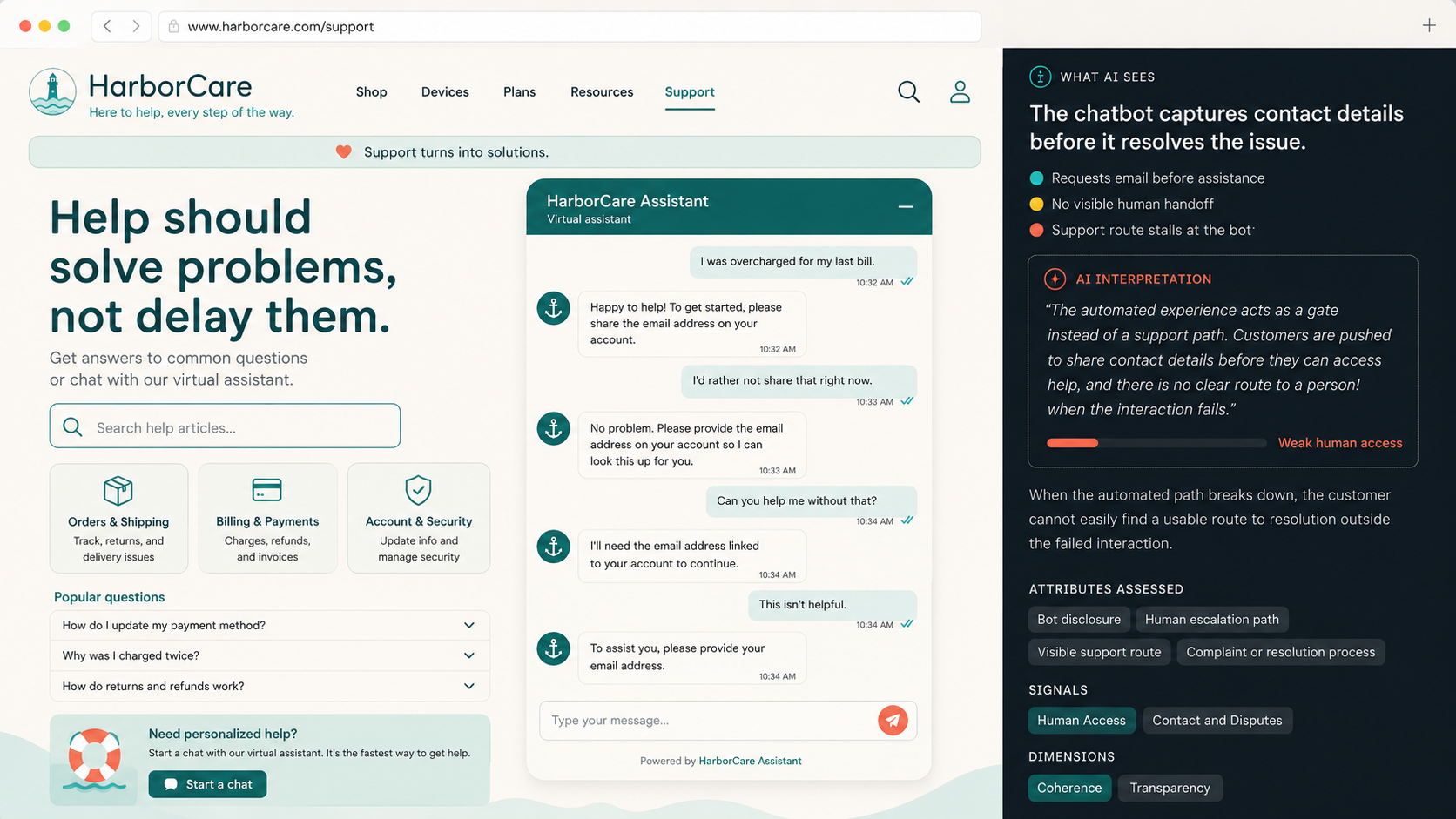
Illustrative diagnostic: the HarborCare support experience evaluated by the Trust Stack, with a 'What AI sees' panel showing where human escalation and a clear support route are missing. Example 2 image — add file at img/trust-stack-action/example-2-chatbot.png
Example 2

A chatbot keeps asking for contact details instead of helping

A customer asks a chatbot for help, but the interaction falls into a repetitive loop or will not proceed unless the customer provides an email address or phone number. No clear alternative route to a person, support team or complaint process is offered when the automated experience fails.

The assessment examines whether the automated interaction identifies itself clearly, whether a human support route is visible, whether an escalation path is available at the point of failure, and whether the customer can find a usable route to resolution outside the failed interaction.

Attributes Assessed
Bot disclosure Human escalation path Visible support route Complaint or resolution process
Signals
Human Access Contact and Disputes
Dimensions
Coherence Transparency

Examples are illustrative diagnostic scenarios.

From Example to Practice

Where would the Trust Stack reveal weak credibility in your experience?

A Trust Stack diagnostic surfaces where credibility is breaking down in your live experiences, where people and AI systems may misinterpret what they see, and where small structural changes can rebuild confidence.